Precision Earth Moving for Foundations and Site Work
Excavation in Lake Helen for builder house pads, utility trenching, foundation preparation, and large-scale earth moving where soil conditions demand equipment precision
Coastal and inland Florida excavation conditions create specific challenges that equipment operators without regional experience routinely encounter mid-project. Clay layers beneath sandy overburden behave unpredictably under load, foundation settling in poorly excavated pads is a common and costly outcome, and drainage compliance in Volusia County's wet zones requires excavation geometry that accounts for stormwater routing from the start. Rough Cut Tractor Service addresses those conditions directly, operating owned heavy equipment across Lake Helen and surrounding areas with an owner-operator model that keeps quality control consistent from first cut to finished grade. Builders and developers who have experienced project continuity problems caused by subcontractor handoffs or equipment rental gaps find the single-operator structure straightforward to work with.
Excavation work at this scale involves more than moving earth from one location to another. Material screening and reuse decisions get made during excavation—sandy overburden that can be stabilized and reused as fill is separated from material that needs to be staged or removed, which affects both project cost and spoil management logistics. On house pad projects, the excavation sequence determines whether the pad will hold consistent bearing capacity across its footprint, and that depends on how clay layers are handled when they appear at inconsistent depths. These are decisions that get made in the field based on what the equipment operator sees in the cut face, which is why owner-operator involvement on every project matters.
Request a project scope review to discuss excavation depth, material staging requirements, and equipment access for your specific build site.
What Proper Excavation Requires on Florida Build Sites
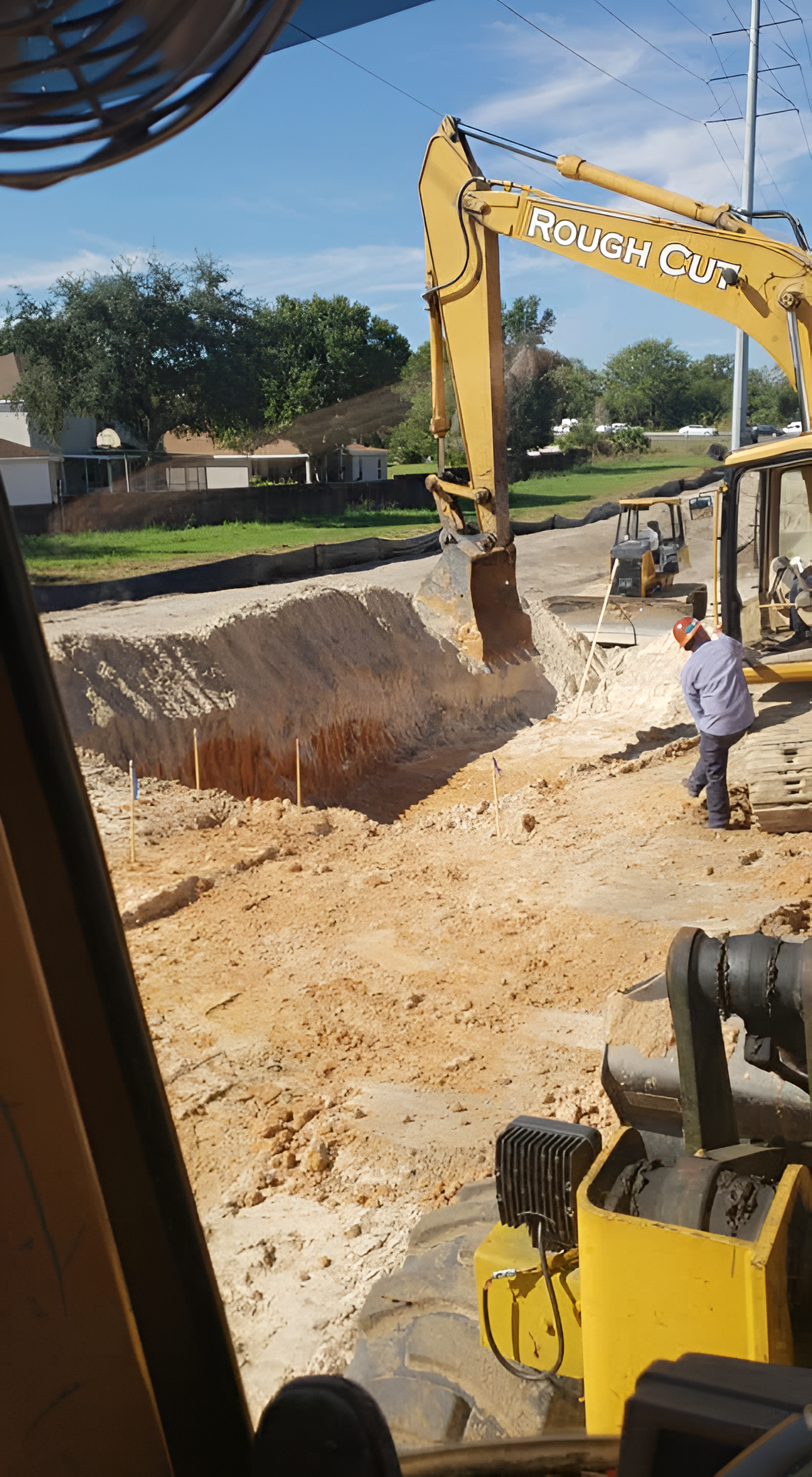
Rough Cut Tractor Service manages excavation projects from initial cut through material staging, backfilling, and final grade—handling spoil on-site rather than routing it through off-site disposal chains that add time and cost. Equipment is owned and maintained by the operation, which means availability is controlled internally rather than subject to rental yard scheduling. Projects in the $5,000 to $150,000-plus range are handled with the same owner-operated approach, and the dirt pit operated by Rough Cut provides fill material for backfilling applications without requiring outside sourcing.
After excavation is complete, the visible result on a house pad project is a level, compacted surface with consistent bearing geometry and defined edges that match the foundation footprint. Areas that previously held standing water during rain events have defined drainage routing. Utility trenches are cut to specified depth and width without over-excavation that would require excess backfill and recompaction. Builders arriving after excavation is finished can read a site that is clearly ready for the next phase rather than one requiring rework before foundation work begins.
Excavation scope is shaped significantly by what sits below the surface—depth to clay, root mass density, buried debris from prior land use, and proximity to wetland buffers all affect how the work proceeds. Sites in Central Florida's I-4 corridor and Volusia County frequently present mixed soil profiles that require the excavation approach to adjust in the field, which is a reason that experienced equipment operators with regional soil familiarity produce more predictable results than crews working from a fixed plan without that context.
What Property Owners Usually Ask About Excavation
Excavation questions from builders and property owners in the Lake Helen area typically center on soil conditions, equipment capability, and how material management works across a project. The answers below cover the most frequent points of clarification.
How does clay layer depth affect excavation planning for a foundation pad?
When clay appears at inconsistent depths across a pad footprint, bearing capacity varies by location—experienced operators identify those zones during excavation and address them through selective over-excavation and engineered backfill rather than grading over the inconsistency.
What happens to excavated material on a job site?
Usable material—sand and screened fill—is staged on-site for backfilling; material that doesn't meet fill specifications is stockpiled separately for removal or disposal, and Rough Cut's owned dirt pit provides an alternative sourcing and disposal option that keeps logistics simpler.
Why does excavation near wetland buffers in Volusia County require additional planning?
Wetland buffer regulations restrict how close excavation can occur to protected vegetation and water features, and those boundaries must be identified and marked before equipment moves—failure to do this results in permit violations that stop projects entirely.
When should excavation be scheduled relative to the wet season in Lake Helen?
Excavation for foundation pads is best completed before peak wet-season saturation because compaction work on water-logged sandy soil loses density, and re-excavating a failed pad after construction has started is significantly more disruptive than scheduling correctly from the start.
How are excavation projects priced when soil conditions are unknown at the outset?
Initial scope estimates account for typical soil profiles in the project area, with field adjustments made if unexpected conditions—buried debris, deep clay layers, or high groundwater—are encountered during excavation.
Rough Cut Tractor Service handles excavation projects across Volusia County with owned equipment and direct owner involvement on every job. Call (386) 479-1457 to discuss your project's excavation requirements and schedule a site evaluation.